-->
Showing posts with label historic. Show all posts

Thursday, March 28, 2013

Cartagena Inside and Out

The stately exterior walls of the legendary Sofitel Hotel Santa Clara display the meticulous restoration of a centuries old convent which contains all of its original interior architectural details as well.


Palm trees thrive inside the courtyard garden, which is now a romantic restaurant serving an elegant fusion of local and French cuisine.


A voluptuous Botero sculpture seems very relaxed in this lush setting, although the current guests of the Hotel generally dress a bit more modestly.


Colombian flowers, exported throughout the world, add color and warmth to this dream-like setting.

 
Relaxing here in the tropical rattan lounge chairs with a white martini supplied by the hotel bar is guaranteed, for a while at least, to make one forget just about everything out there in the real world.
Just outside the Santa Clara is the 500-year-old wall that has protected the old city from outside invaders who were particularly intent on seizing the great amounts of gold stored there. Besides walking on top of the wall, visitors enjoy unobstructed views of the nearby Caribbean Sea through arched openings at street level.
Continuing a stroll by the Sea, one can look back and see the Santa Clara's additional accommodations, and a wall hiding the home of Gabriel Garcia Marquez. 
Next door is another restored convent, this one housing nineteen condos considered to be the most luxurious in Cartagena.
  
With all original architectural details restored, modern amenities, such as private swimming pools and Italian designer kitchens, have been seamlessly added. The classic lines of the old architecture are mirrored in the modern updates as seen from the front entrance looking outward.  
Inside, the beautiful historic colonnades remain surrounding the main lobby, with water flowing in small canals built around palm trees.  
Inside one apartment, even the view from one of four bathrooms is surprising, revealing terra cotta tile roofs, a glimpse of the Sea, and modern Cartagena outside the old city.  


Something in the Cartagena air demands that visitors slow down, relax a bit, and adjust to the local pace. With that in mind, after exploring the wonderful streets of the old city, one tends to find comfortable niches in which to decompress and maybe stretch out on a comfortable sofa.


In this interior, the unfamiliar Middle-Eastern art imported from Dubai adds even more of a feeling of being "away from it all".


More beautiful details recorded by Blanche's unerring photography delight the eyes as one slowly drifts off for a short nap, savoring the reality that our Cartagena truly is an escape to paradise.


Tuesday, March 12, 2013

Faces of Cartagena


Besides the colors and old architecture in Cartagena's historic center, there are the wonderful people - the faces of a walled city that, in many ways, seems immune to the ravages of time. The vendors on the old town streets still ply their trades pretty much the same as they did a century ago. Beauty can be seen in the faces of members of the local community, dressed in traditional fashions, who sell mouth watering, home made candy. 


Food carts with fresh coconuts, fruit, and bread are wheeled up and down the cobblestones, with the proprietors shouting out today's specials so people inside their houses will hear them and come out to buy.
  

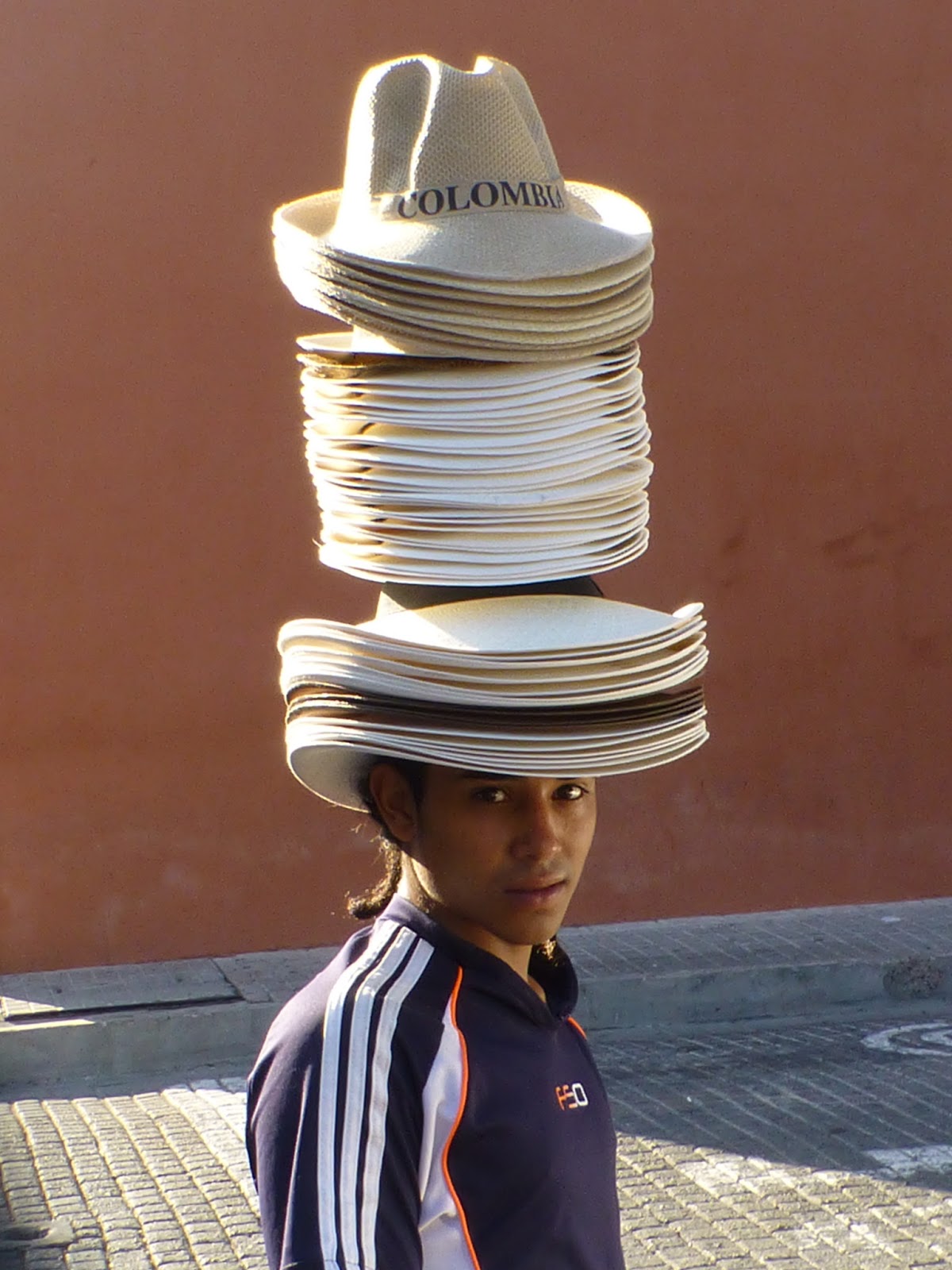
Shoulder bags and hats are popular with the tourists.


Cartagena is a legendary wedding and honeymoon destination, so we joined a crowd watching a beautifully dressed high society wedding party exiting the old Cathedral on their way to celebrate.


Two American tourists, our close friends Rebecca Chapman and Jim Duque, could not resist the hat stand. The same pair of travelers joined a  group of local kids for a photo op. 


It is always a joy to see our first and favorite friend in Cartagena, Maria del Socorro Pinzon, pictured to the right of Rebecca.  


Socorro appears regularly in the society pages of the local newspaper, El Universal, as a prominent fixture at all important Cartagena events involving the arts, antiques, and charities. Her energetic warmth epitomizes the vitality and the soul of this magical city.

Thursday, March 7, 2013

Doors & Windows of Cartagena

Cartagena de los Indios, on the Caribbean coast of Colombia, South America, is a magical city filled with color and mystery. The doors and windows in Cartagena's historic center are seductively painted in rich colors that come alive in the bright sunlit days, and in the romantic, lantern lit streets at night. UNESCO's designation as an important historic area has insured the preservation of the old city with all its architectural
charm. A walking tour of doors and windows is pure pleasure, during which one discovers colorful, fascinating entrances to places that have existed for centuries, glimpses of history literally at your doorstep.


Colonial costumed doormen greet you on the way into one of the restaurants in the legendary Hotel Santa Clara, once a nunnery in Colonial times.


Iron door knockers, seasoned with patina from the salty sea air, announce arrivals at many local houses.  If you come upon a round one like that pictured, give a knock, and I will invite you in to my vacation home, located in the 500-year-old walled city where NYC's bitter winter cold seems very far away.


Friday, October 5, 2012

Vote for Your Candidate! Historic Bandanas for Campaigns for U.S. President

The presidential election season is entering its final days, and the trappings of campaigning are ubiquitous. It's during this quadrennial event that we look back at what Presidential campaigning was before mass media transformed elections into what they are today, replete with television and radio advertising, talk show appearances, and daily news. Long before bumper stickers, there was the colorful, graphic campaign bandana.

Cleveland and Thurman Political Bandana 1888
Grover Cleveland/Allen Thurman Political Bandana 1888
(click for additional info)

Martha Washington probably was not aware that when she commissioned a souvenir bandana depicting an heroic Commander-in-Chief as a surprise gift for her husband, she launched a kind of “bandana bandwagon” that never seems to run out of steam, even to the present day. That particular bandana, thought to be America’s first, is safely secure in the collection of the New York Historical Society, NYC. Important history was recorded in that unique textile, created by a defiant printer, John Hewson, despite the British ban on textile printing. Cannons, flags, and a salute to Washington as founder and protector of liberty and “independency” encircle a strong leader on horseback in this small cloth square, marking the beginning of America’s love affair with the lowly bandana.

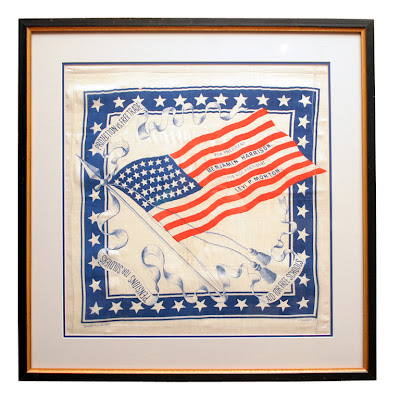
Harrison and Morton Political Bandana 1888
Benjamin Harrison/Levi Morton Political Bandana 1888
(click for additional info)


Pre - television politics in America readily embraced the idea of using bandanas as a means of spreading the word to everyone, including the working classes, whose votes were needed to win elections. Portraits of the candidates surrounded by spectacular patriotic displays of flags, eagles, stars, and inspiring legends, such as PROTECTION & PROSPERITY and TARRIFF REFORM were printed on cotton, and some times silk, as textile advertisements.

Wendell Willke Political Bandana 1940
(click for additional info)
The rage for political bandanas swept the country as an inspiration for songs about the “red bandana”, fashion statements featuring bandanas worn in men’s pockets, the formation of a Bandana Club, and enthusiastic displays of support for political party candidates by fired up delegates, cheering and waving their cloth banners in convention halls.

Campaign Bandana Harrison/Morton 1888
Benjamin Harrison/Levi Morton Campaign Bandana 1888
(click for additional info)
Much of the flavor and fervor of America’s political history has been captured and preserved in these colorful printed cloth squares, documenting important issues of the day, such as fair wages for workers, and even the words and music for a song entitled “We Want Teddy”.
Theodore Roosevelt 1912 Campaign Bandana
Progressive/Roosevelt/1912/Battle Flag
(click for additional info)

The Smithsonian Institute, as well as other museums and private collectors, have recognized the significance of these textiles for providing an exuberant pictorial history of American politics. A number of outstanding examples from their collections are illustrated in Threads of History,(Collins, Smithsonian Institution Press, Washington DC,1979) and The American Bandana,(Weiss, Chronicle Books, San Francisco, 1990), and Long May She Wave (Hinrichs & Hirasuna, Ten Speed Press, Berkeley, 2001).