-->

Wednesday, January 30, 2013

A Tour of The Metro Antiques Show in NYC January 24-27, 2013

The Metro Show was a dazzling and impressive event beautifully staged by top dealers from nearby as well as faraway places. Full of energy and creativity provided by the knowledgeable, enthusiastic specialists in art and antiques, this event is a welcome breath of fresh air, replacing the show formerly sponsored by the Museum of American Folk Art. The show has come into its own under the guidance of a professional team of organizers, retaining the best of past shows plus making new additions and greatly expanding the antiques and art show experience. Each of the various January show events in NYC has its own distinct, unique look and feel - this one is up there with the best.


The antique world's answer to Hollywood glam couples, Tim & Pam Hill,  Hill Gallery, Birmingham, Michigan, welcomed a fellow (former) Midwesterner to their outstanding gallery. Among the rare and intriguing pieces featured are a delightful painted carved folk art figure standing near an amazing pair of  carved limestone lions, circa 1870, from Southern Indiana.
Items that are guaranteed to make one smile are always a treasure to discover at antiques shows.  Also in the booth of Hill Gallery,  Bill Rauhauser's 1960's photograph entitled "Stone Burlesque, Woodward Ave, Detroit" is one of the funniest yet endearing images we have seen in along time.  


Stephen Score, sporting his all-checked ensemble, announced he had just returned from the Czech Republic. We quickly recovered our composure and admired the exciting late 19th-Century one-of-a-kind "Circles" quilt, a universe of appliqued and embroidered round motifs.
Jurassic Park was not nearly as intriguing as the enchanting booth of Il Segno Del Tempo of Milan, Italy
 whose mind boggling exhibit was both amusing and amazing.  When a dealer with imagination and a quirky eye puts together a collection of such unusual items, one is transformed way beyond the ordinary - exciting, oddball objects like a giant vintage black telephone, industrial lighting fixtures artfully hung from the ceiling to form a diagonal line, large metal letters which once lit up (and could again) to advertise "Service", an enormous carousel figure looking somewhat prehistoric - a wonderland of surprises.  Each item, some of rather humble origins, reflects the care with which it was chosen, and somehow conveys a positive message of simple, unadulterated cheer. 


Amy Finkel, the eponymous proprietor of  M. Finkel & Daughter, Philadelphia, PA, seems to have discovered the fountain of youth.  It seems like we have known Amy for many years, but looking at her today, that's impossible. Maybe being around all that school girl needlework keeps her looking like a vivacious recent graduate.  One of her numerous sold pieces was an outstanding New Jersey Sampler by Kiziah Sharp, 1825, Burlington County, complete with family history.


Jeff Bridgman of Jeff Bridgman American Antiques American Flags,  has raised the bar of historic, patriotic textile collections to extraordinary heights.  His lavish exhibit was museum-like, except better because the items were all for sale.  Detailed research information accompanies each piece, such as the elaborate silk banner with George Washington's famous "Prayer at Valley Forge" with gilded text and spectacular bullion trim in mint condition.  


Monday, January 28, 2013

A visit to the Antiques at the Armory Show, NYC, January 25, 2013

A big event in antiques and the arts week in New York City is opening day at the Antiques at the Armory Show near Gramercy Park. This Stella managed winter extravaganza did not disappoint. Always exciting and energetic, the event was jammed with visitors from all over the country, eagerly checking out the fantastic line-up of wares from some of the highest quality dealers in the business. This show differs from many others in that it has elegance, charm, and glamour at, if you look carefully, affordable prices. Here are some of our favorites.
I ordered a pastrami sandwich at this booth before I realized I was in the stall of old friend, dealer Victor Weinblatt.  Victor always manages to come up with wonderful Americana objects, especially his trade signs in old paint that offer sheer delight.

The textiles in Michelle Fox's extensive collection never fail to cause a stir, particularly with her patriotic items including historic flags and antique quilts, all in pristine condition.
Celebrating her birthday today, Country Living magazine columnist and appraiser Helaine Fendelmen chose a festive venue well suited to an expert in all things antique and art, the booth of Scott Bassoff-Sandy Jacobs Antiques. Left of Helaine is her husband, the famous vintage necktie collector, Burton, and to the right, a big admirer of both Fendelmans for four decades(!),  Partner Blanche Greenstein was behind the camera for this tour.

OK, so you wanted to be in shoe business? Sorry, couldn't resist, but this giant shoe in beautiful blue paint, presumably a trade sign for a shoe store, was irresistible in the booth of our old friends, Judy and Jim Milne, NYC.

Two killer hooked rugs and an architectural bird house in old white paint were just part of the knockout display presented by Jewett-Berdan Antiques, New Castle, ME.  


An outstanding collection of Grenfell hooked rugs were featured in the booth of  Robert Snyder-Judy Wilson, Wiscasset, ME. Music provided by antique figural andirons at bottom right. For more information on Grenfell mats, see Silk Stocking Mats written by our old friend, Paula Laverty, whose husband, Bill, is known for his superb taste in serious classic bow ties.

A striking Art Deco-style 4-panel screen painted by renowned painter and architect Richard Haas in 1983 becomes a chic abstract architectural element in the treasure filled booth of our pals, Joan and Harvey Weng.

Monday, January 21, 2013

1st Dibs Celebrates New Book Signing

One of the best things about New York City is - if it's January 17, 2013 - how easy it is to jump in a taxi and in 10 minutes or so you are at 1st Dibs' 5th Avenue digs sipping cocktails in celebration of designer Eric Cohler's new book, Cohler on Design. Ace photographer Blanche Greenstein caught Financial analyst Dawn Wright and me checking out the glorious photographs of rooms created by the well known designer, whose fabrics are currently enjoyed in The White House. The amazing honcho of 1st Dibs, Michael Bruno, once again showed his high style as the sponsor of the very festive event.


Wednesday, December 19, 2012

To our friends in Newtown

Our deepest sympathies to the people of Newtown, Connecticut.  
To our old friend, Scudder Smith, Publisher/Editor of the Newtown Bee, his family, his staff and their families, and all their friends and neighbors in the beautiful community of Newtown.  

The indescribable shock and pain of an unspeakable crime have, as Scudder and his son, David, said, knocked the breath from us and broken our hearts.  That is true of everyone we know outside of Newtown, as well.

Most of all, to the families of the 20  children and the 6 school personnel whose lives were tragically taken in this incomprehensible act, our thoughts are with you, and there are no words to express our sorrow.

Blanche Greenstein
Thomas K. Woodard

Antique Quilts: Celebrating the Holidays


Historically, some of the finest quilts were made to be brought out for special occasions and important events only, like birthdays, anniversaries, Christmas and New Year's. These were the quilts that were carefully handled and preserved, not the utilitarian quilts that were made for everyday use. Holidays offered a time to display the makers' best; those sometimes spectacular displays of exceptional needlework created at home.  

19th- and early 20th-Century mothers and grandmothers were not distracted by things like TV, or jet trips around the world, so they found the time, even while managing a household, to give their undivided attention to quilting. The results were, at times staggering - beautiful, colorful spreads richly filled with fine quilting stitchery. In a way, each quilt in itself was a celebration of the seamstresses’ hard work, determination, and imaginative use of materials at hand, all peculiarly American. Each quilt is a handmade textile greeting card offering warmth and comfort, a personal expression of hope for peace and good will from the quilters of our past.    


Twenty pieced "Sunbursts" explode on a white ground, surrounded with star-like floral motifs and a radiant diamond border. The curious curvilinear motifs appliqued in all four corners add an unusual, art nouveau-like finishing touch. Quilters in 19th-Century America possessed remarkably creative approaches to making bed covers of extraordinary workmanship. 


Here is an exceptional example of a finely appliqued and quilted traditional bed cover of the 19th-Century. Made by a highly skilled quilter, this spread is extraordinarily stitched with elaborate detail. The scalloped inner borders and edges display the work of only the most advanced quilt maker. The "Swag and Tassel" border is on three of the four sides of the quilt, following a nineteenth century tradition which leaves one side for the head of the bed.


Exceptionally large, this finely stitched and quilted spread in a traditional, surprisingly flamboyant pattern, has a mate with slight differences. Pairs or complementing quilts were sometimes made for the dowries of the maker's daughters. It would be difficult to calculate not only the number of stitches but also the amount of love and devotion that went into the making of these outstanding spreads.


The maker set her sights high on this ambitious project - the creation of two magnificent quilts of equal beauty and craftsmanship, perhaps for two daughters to begin their marriages, a popular tradition among 19th-Century American quilters. Slight variations, such as the inner and outer borders, differentiate the two pieces, but both equally retain their rare beauty, thus insuring that neither daughter could ever feel slighted.


Textile folk art flourished in 19th-Century America. It was a time when quilters applied their energies and creativity towards producing bed covers that were not only astonishingly beautiful but uniquely American. Using whatever materials were available and working at home, quilters managed to create pieces that transcended the lowly bedspread and were sometimes worthy of hanging as wall art, although that is a 20th-Century idea. Here, pieced "Lilies" alternate with appliqued "Trees" in a graphic design, delineated by triangle "Sawtooth" outlines, with an outer border of "Vines of Blossoms and Leaves". Quilters never seemed to run out of steam, paying careful attention to every detail all the way to the carefully stitched edges.

 Antique quilt:  "Baskets". American.  Late 19th-Century.  

Although there are many variations of the "Baskets" motif, few are as effectively presented as this example with a rigidly exact arrangement of the motifs.  The "Baskets" are skillfully pieced of solid red with green calicoes, with solid red squares punctuating each quilt block.  The precision of little tin soldiers comes to mind, all lined up on the diagonal across the white ground.  Angular basket handles add a sharp edge to the overall design, and the crisp texture of straight line quilting on a muslin ground provides an effective contrast.

Quilts, America's favorite folk art, are especially welcome to enjoy during the holidays. In some ways, even just viewing their images may offer respite from the tough realities that accompany this 2012 holiday season.  

We at Woodard & Greenstein send you our best wishes for the holidays! 

Monday, December 3, 2012

Looking Back


Every so often a journalist will flatter my partner, Blanche Greenstein, and myself by interviewing us as "influential" or "notable" in expanding people's interest in quilts over the last few decades.  Suddenly feeling like dinosaurs, we are reduced to stumped silence by questions like "What did you do to influence the quilt world, and why?"  The last thing that ever would have occurred to two young, passionate quilt aficionados such as us in the early 1970's was to embark on doing something important and/or significant.  

Our prime focus was to get out there and find the best quilts possible, those amazing and peculiarly American marvels that quilters in the 19th- and early 20th-Century quilters created.  Competition was lively, and getting to flea markets like Shupp's Grove in Pennsylvania before dawn was imperative. Working hurriedly with a flashlight through fresh loads of goodies being brought in by country dealers, was exhausting and, sometimes, exhilarating.  "The lure of the chase" as it has been called was foremost in our minds.  

The delight at occasionally discovering genuine masterpieces is hard to describe.  Those real treasures of the quilting world were on this planet before we arrived, and hopefully will be here long after our departure.  We simply followed our passion, and, with a little luck and a lot of help from friends and clients, we are still at it.  To read more about our partnership, please see our web portrait on Quilt Alliance: http://www.allianceforamericanquilts.org/treasures/main.php?id=5-16-C

Friday, October 5, 2012

Vote for Your Candidate! Historic Bandanas for Campaigns for U.S. President

The presidential election season is entering its final days, and the trappings of campaigning are ubiquitous. It's during this quadrennial event that we look back at what Presidential campaigning was before mass media transformed elections into what they are today, replete with television and radio advertising, talk show appearances, and daily news. Long before bumper stickers, there was the colorful, graphic campaign bandana.

Cleveland and Thurman Political Bandana 1888
Grover Cleveland/Allen Thurman Political Bandana 1888
(click for additional info)

Martha Washington probably was not aware that when she commissioned a souvenir bandana depicting an heroic Commander-in-Chief as a surprise gift for her husband, she launched a kind of “bandana bandwagon” that never seems to run out of steam, even to the present day. That particular bandana, thought to be America’s first, is safely secure in the collection of the New York Historical Society, NYC. Important history was recorded in that unique textile, created by a defiant printer, John Hewson, despite the British ban on textile printing. Cannons, flags, and a salute to Washington as founder and protector of liberty and “independency” encircle a strong leader on horseback in this small cloth square, marking the beginning of America’s love affair with the lowly bandana.

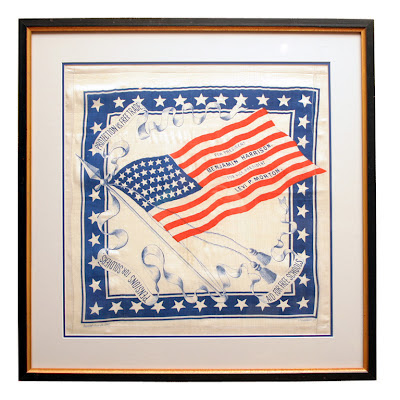
Harrison and Morton Political Bandana 1888
Benjamin Harrison/Levi Morton Political Bandana 1888
(click for additional info)


Pre - television politics in America readily embraced the idea of using bandanas as a means of spreading the word to everyone, including the working classes, whose votes were needed to win elections. Portraits of the candidates surrounded by spectacular patriotic displays of flags, eagles, stars, and inspiring legends, such as PROTECTION & PROSPERITY and TARRIFF REFORM were printed on cotton, and some times silk, as textile advertisements.

Wendell Willke Political Bandana 1940
(click for additional info)
The rage for political bandanas swept the country as an inspiration for songs about the “red bandana”, fashion statements featuring bandanas worn in men’s pockets, the formation of a Bandana Club, and enthusiastic displays of support for political party candidates by fired up delegates, cheering and waving their cloth banners in convention halls.

Campaign Bandana Harrison/Morton 1888
Benjamin Harrison/Levi Morton Campaign Bandana 1888
(click for additional info)
Much of the flavor and fervor of America’s political history has been captured and preserved in these colorful printed cloth squares, documenting important issues of the day, such as fair wages for workers, and even the words and music for a song entitled “We Want Teddy”.
Theodore Roosevelt 1912 Campaign Bandana
Progressive/Roosevelt/1912/Battle Flag
(click for additional info)

The Smithsonian Institute, as well as other museums and private collectors, have recognized the significance of these textiles for providing an exuberant pictorial history of American politics. A number of outstanding examples from their collections are illustrated in Threads of History,(Collins, Smithsonian Institution Press, Washington DC,1979) and The American Bandana,(Weiss, Chronicle Books, San Francisco, 1990), and Long May She Wave (Hinrichs & Hirasuna, Ten Speed Press, Berkeley, 2001).