We are happy to announce the addition of 15 new designs to the Woodard Weave Collection!
Showing posts with label american. Show all posts
Tuesday, October 4, 2016
Friday, August 15, 2014
Our own HOOKED RUG COLLECTION
Geometric designs in hooked rugs have been popular for centuries. Trouble is, the beautiful old ones are fragile and often not suited for everyday use. We have always been big fans of traditional hooked rugs and have come up with a solution - our own collection of historic designs, all based on authentic antique patterns from the past. Virtually any size is possible, and although we discourage soccer teams from working out on them, they do have the strength and integrity of the great old rugs when they were brand new.
The good news is, these geometrics work in so many decors - modern, art deco, traditional, mid-20th-Century, minimalist - so many options. Each rug is hand-hooked with the highest quality, durable cotton. Made to order, virtually any size is possible, from runners to area rugs.
We are genuinely excited to offer these historic carpets available in a wide variety of sizes and colors. Our digital catalog is available by request by e-mailing info@woodardandgreenstein.com
| Triangle Square HR#327 |
![]() |
| Mill Village HR#120 |
![]() |
| Dallas County HR#203A |
![]() |
| New Preston HR#201 |
![]() |
| Ashford Hall HR#204 |
![]() |
| Riverton HR#403 |
Monday, January 20, 2014
The Grand Entrance - Architectural Digest - February 2014
WOODARD WEAVE Stair runner Norfolk #270 adds a strong counter-balance to the dream-like quality of this 1754 Georgian residence in Washington, DC. Old flooring with rich patina is deliberately left bare, a striking contrast to the exotic French scenic wall paper panoramas, as well as the softening texture of the WOODARD WEAVE striped runner on the grand staircase.
Ms. Gomez has managed to fine-tune a flawless, classic setting, mixing a bit of history with a healthy dose of Hollywood glamour. Reminiscent of 19th-Century American muralist Rufus Porter, the romance of the French wallpaper captures the colorful excitement of historic decor confidently at home in any time period. WOODARD WEAVE historic designs are inspired by that same vitality. Timeless.
Image published in February 2014 Issue of Architectural Digest. Article: American Heritage by Douglas Brenner. Photography by Scott Frances. Produced by Howard Christian.
Tuesday, September 24, 2013
Woodard Weave in Traditional Home Magazine
Traditional
Home Magazine's newest issue (October 2013) features WOODARD WEAVE
Runners in some of our most popular stripes. No, they are not awnings
from Venice, although the crisp and colorful stripes do make you feel
like you are in a wonderful place. All of our designs for runners and
area rugs are inspired by authentic antique American designs of a
Century ago. Please see our website to request a digital catalog or order a hard copy.
Tuesday, August 13, 2013
The Big Antiques Events In New Hampshire
Climaxing one of the greatest weeks of the year in American
antiques was the 56th Annual New Hampshire Antiques Show in Manchester,
NH, August 8-10- 2013. It is the exclamation mark for a week of
antiques shows and markets held in the area for which everybody who is
anybody in the field show up to sell, buy, and socialize.
Enthusiasm for antiques shows in recent times may
have dimmed somewhat in other places, but not here. Lines start early
for every event, with dealers, collectors and antiques aficionados as
excited as ever about what treasures they will find.
Amy Finkel, the knowledgeable proprietor of M. Finkel & Daughter, Philadelphia PA, has always added expertise - and glamour - to the antiques world. Her historic samplers and needlework and antique furniture are well known to be first rate. And so is her taste in rugs, as seen in her booth at the recent New Hampshire Antiques Show. WOODARD WEAVE "Hamilton” runners, edged with black binding, serve as the perfect background for exhibiting her outstanding collection.
Wednesday, December 19, 2012
Antique Quilts: Celebrating the Holidays
Historically, some of the finest quilts were made to be
brought out for special occasions and important events only, like birthdays, anniversaries, Christmas and New Year's. These were the quilts that were
carefully handled and preserved, not the utilitarian quilts that were made for everyday use. Holidays offered a
time to display the makers' best; those sometimes spectacular displays of
exceptional needlework created at home.
19th- and early 20th-Century mothers and grandmothers were
not distracted by things like TV, or jet trips around the world, so they found
the time, even while managing a household, to give their undivided attention to
quilting. The results were, at times staggering - beautiful, colorful
spreads richly filled with fine quilting stitchery. In a way, each quilt
in itself was a celebration of the seamstresses’ hard work, determination, and
imaginative use of materials at hand, all peculiarly American. Each quilt is a
handmade textile greeting card offering warmth and comfort, a personal expression of hope for peace and good will from the
quilters of our past.
![]() |
Twenty
pieced "Sunbursts" explode on a white ground, surrounded with star-like
floral motifs and a radiant diamond border. The curious curvilinear
motifs appliqued in all four corners add an unusual, art nouveau-like
finishing touch. Quilters in 19th-Century America possessed remarkably
creative approaches to making bed covers of extraordinary workmanship.
Here
is an exceptional example of a finely appliqued and quilted traditional
bed cover of the 19th-Century. Made by a highly skilled quilter, this
spread is extraordinarily stitched with elaborate detail. The scalloped
inner borders and edges display the work of only the most advanced quilt
maker. The "Swag and Tassel" border is on three of the four sides of
the quilt, following a nineteenth century tradition which leaves one
side for the head of the bed.
Exceptionally
large, this finely stitched and quilted spread in a traditional,
surprisingly flamboyant pattern, has a mate with slight differences.
Pairs or complementing quilts were sometimes made for the dowries of the
maker's daughters. It would be difficult to calculate not only the
number of stitches but also the amount of love and devotion that went
into the making of these outstanding spreads.
The
maker set her sights high on this ambitious project - the creation of
two magnificent quilts of equal beauty and craftsmanship, perhaps for
two daughters to begin their marriages, a popular tradition among
19th-Century American quilters. Slight variations, such as the inner
and outer borders, differentiate the two pieces, but both equally retain
their rare beauty, thus insuring that neither daughter could ever feel
slighted.
Textile
folk art flourished in 19th-Century America. It was a time when quilters applied
their energies and creativity towards producing bed covers that were not
only astonishingly beautiful but uniquely American. Using whatever
materials were available and working at home, quilters managed to create
pieces that transcended the lowly bedspread and were sometimes worthy
of hanging as wall art, although that is a 20th-Century idea. Here,
pieced "Lilies" alternate with appliqued "Trees" in a graphic design,
delineated by triangle "Sawtooth" outlines, with an outer border of "Vines of Blossoms and Leaves". Quilters never seemed to run out of
steam, paying careful attention to every detail all the way to the
carefully stitched edges.
Antique quilt: "Baskets". American. Late 19th-Century.
Although
there are many variations of the "Baskets" motif, few are as effectively
presented as this example with a rigidly exact arrangement of the
motifs. The "Baskets" are skillfully pieced of solid red with green
calicoes, with solid red squares punctuating each quilt block. The
precision of little tin soldiers comes to mind, all lined up on the
diagonal across the white ground. Angular basket handles add a sharp
edge to the overall design, and the crisp texture of straight line
quilting on a muslin ground provides an effective contrast.
Quilts, America's favorite folk art, are especially welcome to enjoy during the holidays. In some ways, even just viewing their images may offer respite from the tough realities that accompany this 2012 holiday season.
We at Woodard & Greenstein send you our best wishes for the holidays!
Monday, December 3, 2012
Looking Back
Every so often a journalist will flatter my partner, Blanche
Greenstein, and myself by interviewing us as "influential" or
"notable" in expanding people's interest in quilts over the last few
decades. Suddenly feeling like dinosaurs, we are reduced to stumped
silence by questions like "What did you do to influence the quilt world,
and why?" The last thing that ever would have occurred to two young,
passionate quilt aficionados such as us in the early 1970's was to embark on
doing something important and/or significant.
Our prime focus was to get out there and find the best
quilts possible, those amazing and peculiarly American marvels that quilters in
the 19th- and early 20th-Century quilters created. Competition was
lively, and getting to flea markets like Shupp's Grove in Pennsylvania before dawn was imperative.
Working hurriedly with a flashlight through fresh loads of goodies being
brought in by country dealers, was exhausting and, sometimes, exhilarating.
"The lure of the chase" as it has been called was foremost in
our minds.
The delight at occasionally discovering genuine masterpieces
is hard to describe. Those real treasures of the quilting world were on
this planet before we arrived, and hopefully will be here long after our
departure. We simply followed our passion, and, with a little luck and a
lot of help from friends and clients, we are still at it. To read more
about our partnership, please see our web portrait on Quilt Alliance: http://www.allianceforamericanquilts.org/treasures/main.php?id=5-16-C
Labels:
19th century,
20th century,
american,
americana,
antiques,
dealers,
flea markets,
influential,
masterpiece,
Quilt Alliance,
quilters,
quilts,
rare,
woodard and greenstein,
Woodard Weave
Friday, October 5, 2012
Vote for Your Candidate! Historic Bandanas for Campaigns for U.S. President
The presidential election season is entering its final days, and the trappings of campaigning are ubiquitous. It's during this quadrennial event that we look back at what Presidential campaigning was before mass media transformed elections into what they are today, replete with television and radio advertising, talk show appearances, and daily news. Long before bumper stickers, there was the colorful, graphic campaign bandana.
![]() |
| Grover Cleveland/Allen Thurman Political Bandana 1888 (click for additional info) |
Martha Washington probably was not aware that when she commissioned a souvenir bandana depicting an heroic Commander-in-Chief as a surprise gift for her husband, she launched a kind of “bandana bandwagon” that never seems to run out of steam, even to the present day. That particular bandana, thought to be America’s first, is safely secure in the collection of the New York Historical Society, NYC.
Important history was recorded in that unique textile, created by a defiant printer, John Hewson, despite the British ban on textile printing. Cannons, flags, and a salute to Washington as founder and protector of liberty and “independency” encircle a strong leader on horseback in this small cloth square, marking the beginning of America’s love affair with the lowly bandana.
Pre - television politics in America readily embraced the idea of using bandanas as a means of spreading the word to everyone, including the working classes, whose votes were needed to win elections. Portraits of the candidates surrounded by spectacular patriotic displays of flags, eagles, stars, and inspiring legends, such as PROTECTION & PROSPERITY and TARRIFF REFORM were printed on cotton, and some times silk, as textile advertisements.
The rage for political bandanas swept the country as an inspiration for songs about the “red bandana”, fashion statements featuring bandanas worn in men’s pockets, the formation of a Bandana Club, and enthusiastic displays of support for political party candidates by fired up delegates, cheering and waving their cloth banners in convention halls.
Much of the flavor and fervor of America’s political history has been captured and preserved in these colorful printed cloth squares, documenting important issues of the day, such as fair wages for workers, and even the words and music for a song entitled “We Want Teddy”.
The Smithsonian Institute, as well as other museums and private collectors, have recognized the significance of these textiles for providing an exuberant pictorial history of American politics. A number of outstanding examples from their collections are illustrated in Threads of History,(Collins, Smithsonian Institution Press, Washington DC,1979) and The American Bandana,(Weiss, Chronicle Books, San Francisco, 1990), and Long May She Wave (Hinrichs & Hirasuna, Ten Speed Press, Berkeley, 2001).
![]() |
| Benjamin Harrison/Levi Morton Political Bandana 1888 (click for additional info) |
Pre - television politics in America readily embraced the idea of using bandanas as a means of spreading the word to everyone, including the working classes, whose votes were needed to win elections. Portraits of the candidates surrounded by spectacular patriotic displays of flags, eagles, stars, and inspiring legends, such as PROTECTION & PROSPERITY and TARRIFF REFORM were printed on cotton, and some times silk, as textile advertisements.
![]() |
| Wendell Willke Political Bandana 1940 (click for additional info) |
![]() |
| Benjamin Harrison/Levi Morton Campaign Bandana 1888 (click for additional info) |
![]() |
| Progressive/Roosevelt/1912/Battle Flag (click for additional info) |
The Smithsonian Institute, as well as other museums and private collectors, have recognized the significance of these textiles for providing an exuberant pictorial history of American politics. A number of outstanding examples from their collections are illustrated in Threads of History,(Collins, Smithsonian Institution Press, Washington DC,1979) and The American Bandana,(Weiss, Chronicle Books, San Francisco, 1990), and Long May She Wave (Hinrichs & Hirasuna, Ten Speed Press, Berkeley, 2001).
Monday, August 27, 2012
Labor Day is on it's way
Labor Day weekend is just about here! The perfect time to get out of the city and into the country to enjoy the fresh air, friends and family. In anticipation of the break we pulled together a few paintings and pieces all about travel and relaxation. As always, more information about our antiques is available on 1st Dibs. We hope you enjoy, and have a wonderful Labor Day!
![]() |
| Quebec Decoy early 20th century. Distinctive carving on tail feathers and wings, with blue and white painted details on wings, green painted beak. |
![]() |
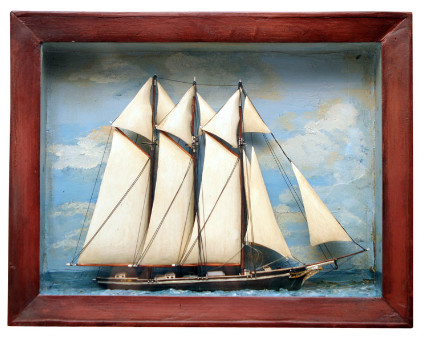
| Sailing Ship Diorama late 19th-Century. Carved and painted three-dimensional image of sailing ship in wood frame behind glass. |
![]() |
| Royal Scot Locomotive circa 1923-25. Magnificent train, said to be the 6100-First Engine, early LMS (London-Midland-Scotland). |
![]() |
| Pair of Golfer Bookends early 20th century. Detailed figures, each standing on a book. |
![]() |
| Grenfell Mat: Mallard Ducks Take Flight, circa 1930. Handmade by well-known cottage industry. Pictured in Silk Stocking Mats, Laverty, Paula, Page 84. Exceptionally vivid colors. |
![]() |
| Gone Fishing early 20th century. A watercolor image of two men fishing. Inscribed "Too Bad", probably referring to the one that got away. |
![]() |
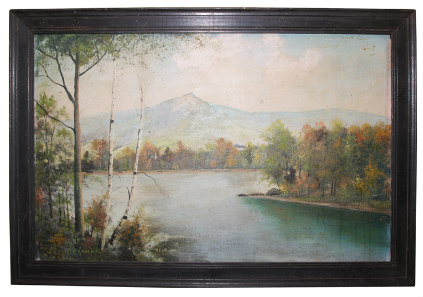
| Rustic Landscape dated 1923. Oil on canvas. A finely detailed autumn scene. Signed and dated "R.M. Kelly. 10-23-26". All original in original frame, no restoration. |
Monday, July 2, 2012
Celebrating the Fourth
Over the years Woodard and Greenstein has acquired many rare pieces of Americana, including an extensive collection of 19th and 20th century campaign bandannas, and what more fitting time to showcase these unique and charming finds than on the Fourth of July? Here's a sampling of our favorite pieces paying homage to the red white and blue. As always, these and other American antiques can be found and purchased on 1stdibs.com. Have a happy Fourth!
![]() |
| Applique and Pieced Quilt top: GOD BLESS AMERICA c.1914-1920. A patriotic handmade quilt top mounted on stretchers with 48-star American flag, and a soldier at the pole base. |
![]() |
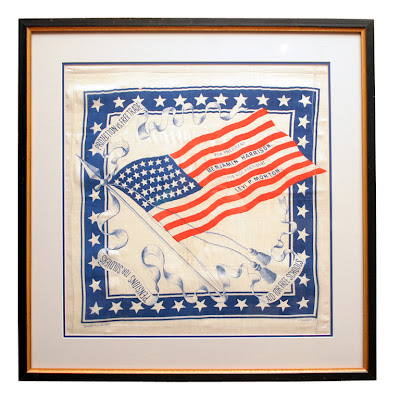
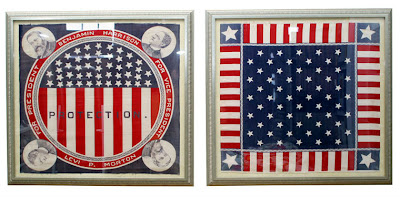
| Campaign Bandanna: Harrison/Morton 1888. Inscribed "Protect Home Industry" with portraits of the candidates. |
![]() |
| Political Bandanna: Harrison/Morton 1888. Inscribed "Protection vs. Free Trade / "Pension for Soliders / Aid for Free Schools". |
![]() |
| Political Bandanna: Wendell Wilkie 1940. Wendell Wilkie campaigned against Franklin D. Roosevelt in the 1940 presidential election. |
![]() |
| Pair of Campaign Bandannas 1888. A pair of Harrison/Morton bandannas, included in "Threads of History" published by the Smithsonian Institute. |
![]() |
| Antique Quilt: Feathered Star Variation: Late 19th century finely pieced graphic variation of traditional design in red, white, and blue. |
![]() |
| Pair of miniature Adirondack chairs and single Adirondack chair c. early 20th century. A charming pair of red and white painted wood miniature chairs, and a single red painted wood miniature chair. |
![]() |
| Trade Sign: National Union Fire Insurance Company c. 1900. Red white and blue patriotic shield with capitol building inspiring trust and confidence. |
![]() |
| Paper covered barrel cover c. early 20th century. Patriotic colors and motifs decorate this exuberant advertisement for an American flour company. |
![]() |
| Woodard Weave design Georgetown 254 brings our love of Americana to our Woodard Weave Woven Rug collection with bold red, white and blue. |
Subscribe to:
Posts (Atom)